Urban logistics is poised for a major transformation. Just as shipping containers revolutionised global trade in the 20th century, containerised cargo bikes are now set to dramatically reshape the way goods are delivered in our cities.
Currently, cargo bikes account for under 10% of urban parcel deliveries. But with the rise of modular containerisation — where goods are pre-packed off-site into swappable boxes for direct handoff to cargo bikes — that share could reach 50% in the next decade. The shift is already underway, as demonstrated by recent DfT-funded trials led by XeroE in Bristol and Glasgow with Varamis Rail, Whistl and Delivery Mates.
There are obvious parallels with shipping containerisation. That system removed the need for dockside labour, unpacking, sorting, and warehousing, allowing sealed containers to go straight from ship to customer. The result: lower costs, higher security, faster turnaround — and ultimately, globalisation.
A similar revolution is now occurring in last-mile logistics. Until now, sustainable deliveries via cargo bike have depended on expensive urban "micro-hubs" where goods are sorted and loaded. These hubs require space, staffing, scanning systems, and are often only used for a few hours a day. And they only allow cargo bikes to serve a limited local area. As first drop distance and stem time increases, vans become more cost effective.
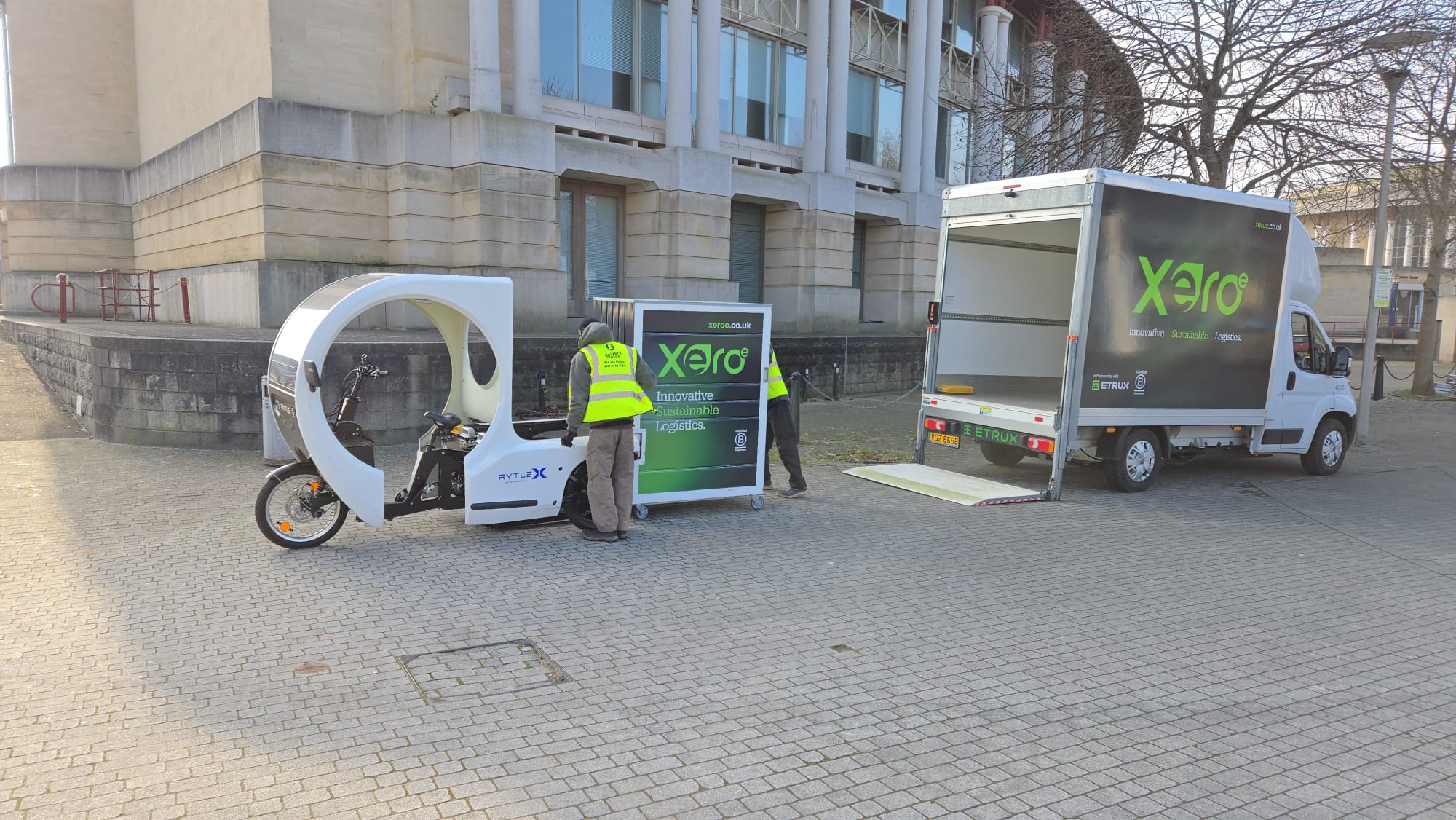
Containerised cargo bikes eliminate this inefficiency entirely. Goods are pre-sorted by route outside the city, packed into modular containers, and dropped at multiple "virtual hubs" that require no permanent infrastructure. These handoff points, active for just 10 minutes a day, allow bikes to start deliveries close to their first drop — improving time efficiency while slashing operational costs.
Containerisation also facilitates a sustainable middle mile using electric Varamis freight trains and, starting in 2026, the all-electric Thames Clipper freight vessel. These services enable container delivery by rail and river directly into city centres, further cutting road congestion and emissions.
A major reason this model works is that it solves the scalability issue. Instead of building dozens of costly small depots, carriers can use a small fleet of containers swapped in and out daily. It's flexible, fast, and frictionless.
While early containerised cargo bikes like RYTLE and ONO helped shape the technology, it is the integration of those containers into intelligent, intermodal systems that unlocks real impact. Platforms like IM Flow — currently under development — will coordinate the packing, routing, and timing of these deliveries across multiple modes.
What containerisation did for ships, cargo bike containers will now do for cities: simplify logistics, cut handling costs, and eliminate unnecessary infrastructure.
Scaling this model depends on a few key enablers: local authority support for loading zones, industry standardisation of container formats, and investment in digital coordination. But the economic and environmental case is clear. With containerised cargo bikes and virtual hubs, the final mile can be clean, efficient, and affordable.
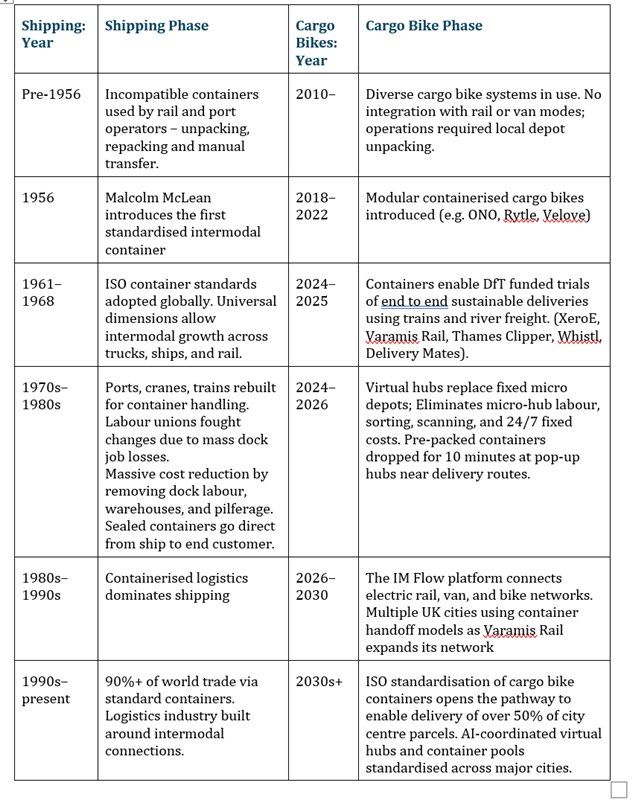
Shipping containerisation led to Globalisation.
Cargo bike containerisation will lead to Localisation — of the last mile.